New to Therapy? Understanding Mental Health Levels of Care
Entering the therapy space can feel overwhelming. Where do you start? Who do you reach out to? And what level of care should you be in? For those navigating the space for the first time, these questions can feel daunting. That’s why we want to help make it a bit easier.
The first place to start when thinking about therapy services is to ask: what type of treatment am I looking for? Am I looking for once-a-week sessions or 24-hour support? This brings us to the level of care continuum. Level of care in the mental health world refers to the different intensities of treatment services.
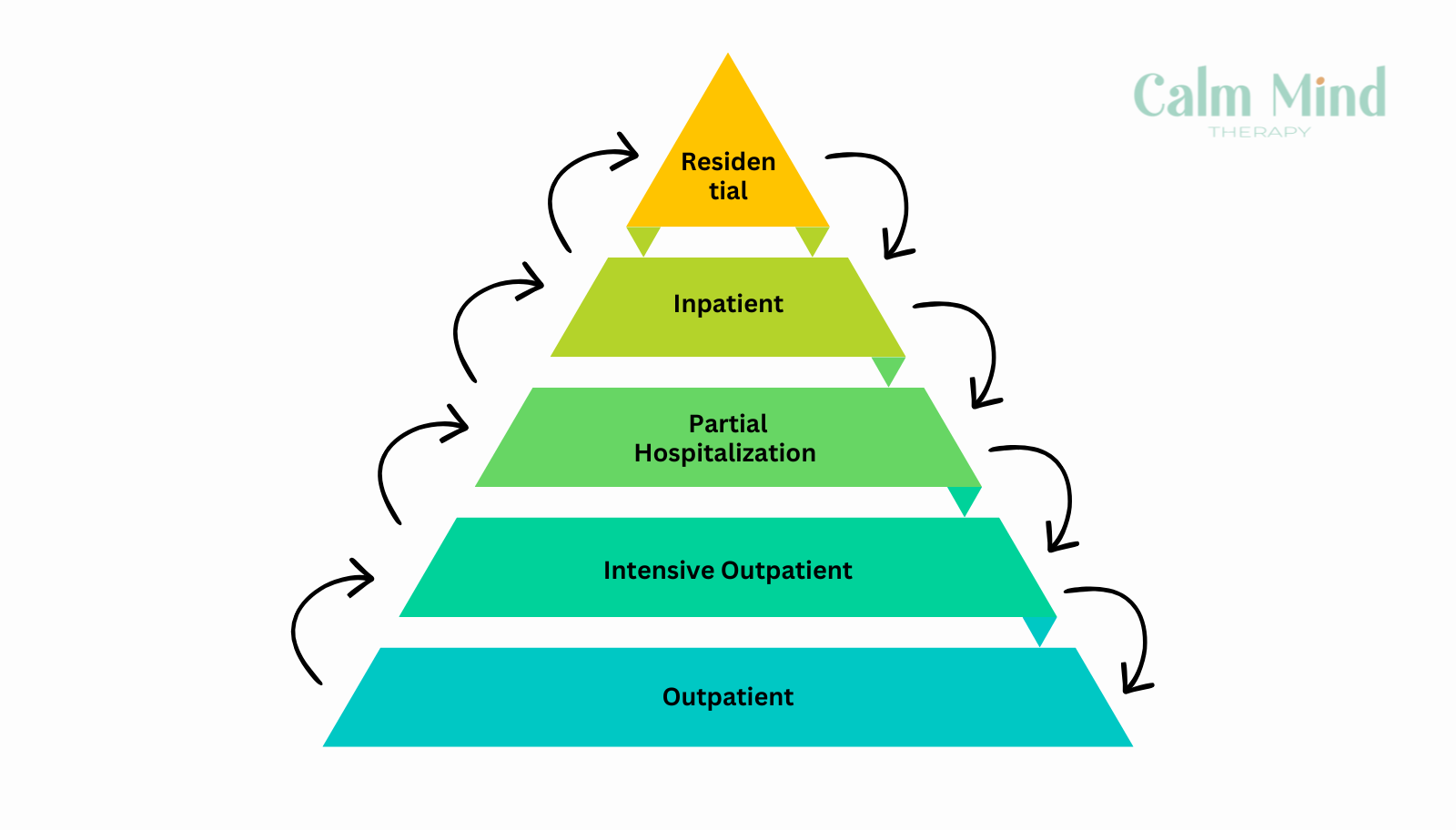
The diagram below highlights the different levels of mental health treatment and shows how people can move both up and down the rungs of care.
What is outpatient therapy?
The first level of mental health care is called outpatient treatment. Outpatient treatment usually consists of weekly to monthly sessions with a mental health therapist. These sessions are typically about 50 minutes in length and can be short- or long-term care. Common reasons people seek outpatient therapy include managing life transitions, general stress, low mood, relationship challenges, and more. Outpatient therapy is the least restrictive form of mental health treatment.
Our team at Calm Mind Therapy provides outpatient therapy services. Outpatient treatment might be a perfect form of care, but if you’re finding your mental health needs feel more severe and you need additional support, intensive outpatient treatment is the next step.
What is intensive outpatient (IOP) treatment?
Intensive outpatient treatment (IOP) increases the frequency and length of therapy. IOP programs offer about three hours of mental health treatment three to five days a week. The program usually consists of group therapy, as well as individual therapy. IOP programs typically last between two and four weeks in total. IOP is a great option if you’re finding you need more touchpoints than weekly outpatient therapy. Once clients successfully complete IOP treatment, many drop back down to outpatient work.
If, during the course of IOP treatment, you find that you need additional support, clients can then move up to partial hospitalization programs.
What is a partial hospitalization program (PHP)?
PHP programs are similar to IOP programs but typically run five days a week for a minimum of five hours a day. The program is mostly group therapy, along with individual and family therapy. PHP also often provides medication management through a psychiatrist or nurse practitioner. For children and teens, PHP also includes time to complete schoolwork. PHP can serve as a step down in care from inpatient treatment or a step up in care from IOP.
If someone needs 24/7 support, we then begin looking at inpatient options.
What is inpatient mental health treatment?
Inpatient mental health treatment is provided in a hospital-like setting. Admission usually occurs through an emergency room and is appropriate if someone is a threat to themselves or others. Inpatient treatment provides 24/7 care and monitoring. Clients receive medication management through a psychiatrist, individual therapy, group therapy, and some family involvement. Inpatient care tends to focus on stabilization before referring clients to another level of care.
What is residential treatment?
Residential treatment is the highest level of mental health care. This type of treatment usually involves stays in facilities lasting one month or longer. Clients live, eat, and sleep at the program to receive extended support. Treatment typically includes group therapy, individual therapy, family therapy, medication management, and some experiential therapeutic models. Residential programs may focus on general mental health or be more specific, such as for substance use or eating disorders.
Once a client completes residential treatment, they typically climb back down the rungs of care. It’s also important to remember that healing is not linear. Moving up and down the levels of care can be a necessary and helpful part of the healing process.
There you have it, our basic outline highlighting the different levels of care in the mental health space. If you are interested in getting started in treatment, feel free to reach out to us for a free phone consultation to discuss your needs, and we can help you identify the treatment that is right for you.
*************
Calm Mind Therapy is a boutique mental health practice located in Ardmore, PA, specializing in the care of children, adolescents, and adults. Our mission is to provide the Main Line with high-quality mental health services for all ages. Our goal is to help our clients achieve emotional well-being and build a life worth living. Serving clients in Ardmore, Bryn Mawr, Wynnewood, Narberth, Radnor, Lower Merion, Haverford, Havertown, Villanova, Swarthmore, Devon, Berwyn, Malvern, Bala Cynwyd, and more.